


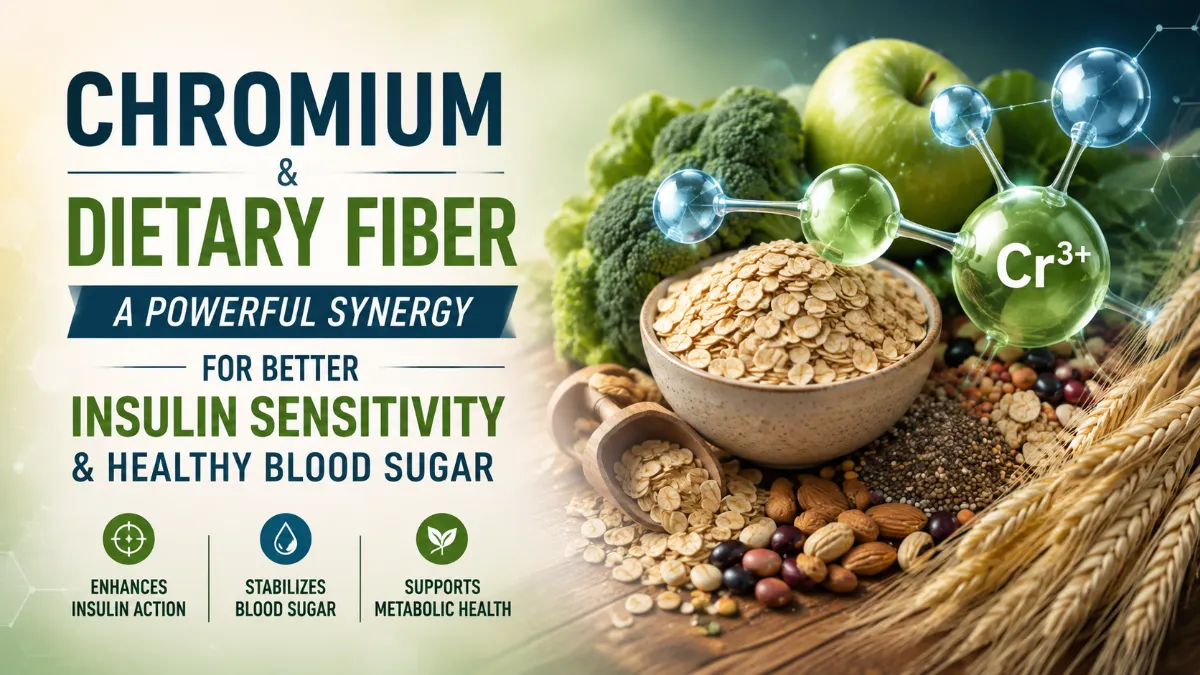
Micro-Nutritional Synergies: How Chromium and Dietary Fiber Enhance Insulin Sensitivity
Understand how chromium and soluble dietary fiber work synergistically at the molecular level to enhance insulin receptor sensitivity, improve glucose transporter function, and support long-term glycemic control in Type 2 diabetes.
Article Snapshot
Comprehensive guide discussing Micro-Nutritional Synergies: How Chromium and Dietary Fiber Enhance Insulin Sensitivity. Focuses on cellular pathophysiology, phytotherapy, low-GI nutrition, and integrative diabetic care.
- Understands cellular mechanisms of insulin resistance and beta cell stress.
- Highlights key botanical compounds like Gymnema, Curcumin, Amla, and Vijaysar.
- Explains sublingual delivery benefits in avoiding hepatic first-pass degradation.
- Provides dietary guidelines on low-GI rice, millets, barley, and fiber.
- Emphasizes clinical laboratory validation and integrative organ protection.
Medical Review & Verification
In the complex biochemistry of glucose metabolism and insulin action, individual nutrients rarely function in isolation. The emerging science of nutritional synergy reveals that certain micronutrients and dietary components achieve substantially greater metabolic effects when present together than either could accomplish independently. Nowhere is this synergistic principle more therapeutically relevant than in the relationship between chromium—an essential trace mineral—and dietary fiber—a structural carbohydrate component—in the regulation of insulin sensitivity and glycemic homeostasis.
Chromium: The Insulin-Potentiating Trace Mineral
Chromium trivalent (Cr³⁺) is an essential trace mineral required by the human body in microgram quantities—the estimated adequate intake for adults is 25–35 micrograms per day—yet its impact on glucose metabolism is disproportionate to this tiny physiological requirement. Chromium functions primarily as a cofactor for chromodulin (previously called low-molecular-weight chromium-binding substance or LMWCr), an intracellular oligopeptide that plays a critical regulatory role in amplifying the insulin signaling cascade.
The mechanism works as follows: when insulin binds to its receptor on cell surfaces, the resulting conformational change in the receptor's alpha subunit generates a signal that activates chromodulin by promoting chromium transfer into the receptor complex. Chromodulin, once activated by chromium loading, binds to the insulin receptor's tyrosine kinase domain and amplifies the receptor's inherent kinase activity—increasing its capacity for autophosphorylation and its ability to phosphorylate downstream insulin receptor substrate (IRS) proteins. This amplification of insulin receptor tyrosine kinase activity translates directly into enhanced sensitivity to insulin—meaning that less insulin is required to achieve the same degree of glucose disposal into cells.
Chromium Deficiency and Insulin Resistance
Population-level data indicates that chromium deficiency is considerably more prevalent than commonly recognized, particularly among people consuming Western-style diets dominated by refined foods that have been stripped of chromium during processing. Whole grain cereals, legumes, broccoli, and certain meats are the primary dietary chromium sources; the refining of whole wheat flour into white flour removes approximately 80% of chromium content.
Clinical manifestations of chromium inadequacy include progressive insulin resistance, impaired glucose tolerance, elevated fasting insulin levels, and dyslipidemia—a syndrome that mirrors the early metabolic profile of pre-diabetes. Multiple randomized controlled trials have demonstrated that chromium supplementation in insulin-resistant individuals improves fasting glucose, postprandial glucose, HbA1c, and HOMA-IR (a mathematical index of insulin resistance) compared to placebo, with the largest effect sizes observed in individuals with the most pronounced baseline chromium insufficiency.
Chromium in GLUT-4 Translocation
Beyond its role in insulin receptor amplification, chromium influences downstream insulin signaling through effects on GLUT-4 (glucose transporter type 4) translocation. GLUT-4 is the insulin-sensitive glucose transporter predominantly expressed in skeletal muscle and adipose tissue—the primary peripheral glucose disposal tissues. In response to insulin signaling, GLUT-4-containing intracellular vesicles translocate to the plasma membrane, dramatically increasing cellular glucose uptake capacity.
Chromium has been shown to enhance both the magnitude and speed of insulin-stimulated GLUT-4 translocation in skeletal muscle cells, increasing the maximal glucose transport velocity (Vmax) without affecting the half-maximal effective concentration (EC50) of insulin required for translocation—indicating true insulin receptor sensitization rather than mere additive glucose transport stimulation. This GLUT-4 translocation enhancement is mediated through chromium's amplification of the PI3K/Akt signaling axis, the primary intracellular cascade linking insulin receptor activation to GLUT-4 vesicle mobilization.
Dietary Fiber: The Glycemic Architecture of Carbohydrate Foods
Dietary fiber—the non-digestible carbohydrate and lignin components of plant cell walls—modulates glycemic response through both physical and biochemical mechanisms that are distinct from, yet complementary to, the chromium-mediated receptor sensitivity pathway. Understanding fiber's multiple modes of action clarifies why it constitutes an indispensable component of any effective metabolic nutrition strategy.
Soluble Fiber: Viscosity-Mediated Glycemic Blunting
Soluble dietary fiber—including beta-glucans from oats and barley, pectins from fruits and vegetables, guar gum from legumes, and psyllium husk—dissolves in water to form viscous gels within the gastrointestinal tract. This gel formation has several mechanistic consequences for glycemic regulation:
First, the viscous gel physically coats the intestinal epithelial surface, increasing the effective unstirred water layer thickness that glucose and other nutrients must diffuse across to reach absorptive enterocytes. This increased diffusion distance substantially reduces the rate—though not the total amount—of glucose absorption, smoothing the glycemic response curve by reducing peak concentration and extending the absorption window.
Second, soluble fiber slows gastric emptying—the rate at which digested food moves from the stomach into the small intestine. By increasing gastric content viscosity, soluble fiber activates gastric mechanoreceptors that reflexively slow pyloric opening, extending the gastric phase of digestion. Slower gastric emptying means a more gradual and controlled delivery of glucose to the intestinal absorptive surface, reducing the amplitude of postprandial glucose excursions.
Third, viscous soluble fibers, particularly oat beta-glucan, have been shown to reduce the activity of pancreatic amylase—the primary starch-digesting enzyme—by restricting enzyme access to substrate starch molecules entrapped within the fiber matrix. This selective enzyme inhibition reduces the rate of starch hydrolysis to glucose within the intestinal lumen, further moderating the glycemic response.
Beta-Glucan: The Premier Glycemic-Modulating Fiber
Among soluble fibers, oat and barley beta-glucan has attracted the most rigorous scientific attention for glycemic management. Beta-glucan is a linear polysaccharide composed of glucose units linked by mixed beta-(1,3) and beta-(1,4) glycosidic bonds—a unique structural arrangement that confers high viscosity at relatively low concentrations. The viscosity of beta-glucan solutions correlates directly with their glycemic-modulating potency; high-molecular-weight beta-glucan preparations produce greater viscosity and correspondingly greater reductions in postprandial glucose compared to lower-molecular-weight variants.
The European Food Safety Authority (EFSA) has approved a health claim stating that 3 grams of oat or barley beta-glucan per day reduces postprandial blood glucose response—one of only a handful of dietary fiber health claims supported by sufficient clinical evidence to meet regulatory approval standards. Multiple meta-analyses of randomized controlled trials confirm that beta-glucan supplementation significantly reduces fasting glucose, postprandial glucose, and HbA1c in Type 2 diabetes populations, with effect sizes increasing with longer supplementation duration and higher beta-glucan doses.
Insoluble Fiber: Intestinal Transit and Microbiome Support
Insoluble dietary fiber—including cellulose from grain bran, hemicellulose from vegetables, and lignin from woody plant tissues—does not dissolve in water and does not form gels, but contributes to glycemic regulation through distinct mechanisms. Insoluble fiber increases fecal bulk, accelerates intestinal transit time, and reduces the duration of mucosal contact between glucose-containing digesta and absorptive enterocytes. It also provides the structural matrix of the plant food that physically encapsulates starch granules—a phenomenon termed "intact cell entrapment"—rendering enclosed starch granules inaccessible to amylase enzymes until cell wall disruption occurs during mastication or digestion.
Insoluble fiber fermentation in the colon, while less extensive than soluble fiber fermentation, nonetheless supports a diverse gut microbiome composition associated with improved insulin sensitivity and reduced systemic inflammation—particularly through the promotion of cross-feeding between microbiome species that collectively maximize SCF production.
The Synergistic Interaction Between Chromium and Dietary Fiber
The metabolic synergy between chromium and dietary fiber operates at complementary physiological levels that together create a more robust and comprehensive insulin-sensitizing effect than either nutrient achieves independently. Dietary fiber reduces the rate of glucose absorption, preventing the acute hyperglycemic spikes that trigger maximal insulin secretory demands. By moderating the amplitude of postprandial glucose excursions, fiber reduces the degree of insulin receptor downregulation that occurs in response to chronic hyperinsulinemia—preserving receptor expression and affinity.
Chromium, operating at the receptor and post-receptor signaling level, ensures that when insulin is secreted in response to the moderated glucose rise facilitated by dietary fiber, the insulin receptor complex is in an optimally sensitized state—with chromodulin fully loaded and functioning to amplify receptor tyrosine kinase activity. The GLUT-4 translocation that follows is therefore more efficient, achieving greater glucose disposal per unit of insulin—precisely the definition of improved insulin sensitivity.
Furthermore, the short-chain fatty acids produced from soluble fiber fermentation—particularly butyrate and propionate—activate free fatty acid receptors (FFAR2 and FFAR3) on enteroendocrine L-cells in the distal intestine, stimulating the release of glucagon-like peptide-1 (GLP-1) and peptide YY (PYY). GLP-1 enhances glucose-dependent insulin secretion from pancreatic beta cells and suppresses glucagon release—effects that synergize with chromium's insulin receptor sensitization to further reduce fasting and postprandial glucose levels.
Dietary Sources and Practical Implementation
Optimizing dietary chromium and fiber intake through food selection is achievable with systematic dietary guidance. For chromium: barley, broccoli, green beans, beef liver, whole wheat bread, and certain spices (particularly black pepper and brewer's yeast) provide meaningful chromium quantities. For soluble fiber: oats, barley, lentils, kidney beans, apples, and psyllium husk are excellent sources. For insoluble fiber: whole wheat bran, ragi, foxtail millet, and most vegetables provide the complementary insoluble fraction.
The concept of chromium and fiber synergy is embedded within traditional Indian dietary patterns—where whole grain millets, lentil-based dishes (dal), and fiber-rich vegetables have coexisted for millennia. Modern dietary patterns that replace these traditional food combinations with refined carbohydrates and processed foods simultaneously deplete dietary chromium and strip dietary fiber—a double metabolic disadvantage that amplifies insulin resistance development in susceptible populations.
Clinical Monitoring of Insulin Sensitivity Improvement
Tracking improvements in insulin sensitivity from chromium and fiber optimization requires specific laboratory assessments. HOMA-IR (fasting glucose × fasting insulin / 22.5) provides a practical clinical estimate; decreasing HOMA-IR over 12–16 weeks of dietary optimization indicates improving insulin sensitivity. Fasting insulin levels alone provide additional insight—declining fasting insulin suggests that less insulin is needed to maintain euglycemia, consistent with enhanced receptor sensitivity. Adiponectin levels, which inversely correlate with insulin resistance, serve as an additional biomarker; increasing adiponectin confirms improved metabolic status at the adipose tissue level.
Sources and References
Frequently Asked Questions
Targeted botanical compounds help neutralize free radicals in pancreatic islet cells and enhance peripheral insulin receptor sensitivity.
Low-GI foods release glucose slowly into the bloodstream, avoiding postprandial glucose spikes and reducing insulin demand.