


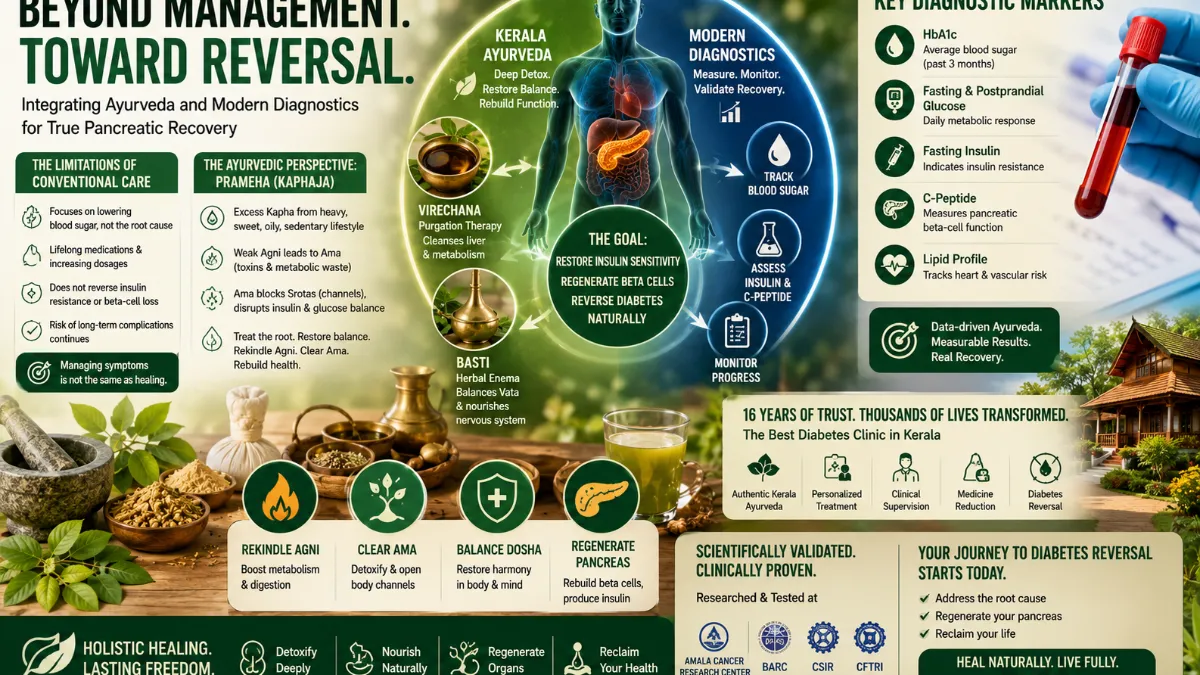
The Holistic Path to Diabetes Reversal: Integrating Modern Diagnostics with Traditional Kerala Ayurveda
Discover how combining advanced modern blood diagnostics with the ancient, root-cause healing principles of authentic Kerala Ayurveda offers a comprehensive, proven path to reversing Type 2 diabetes.
Article Snapshot
This article describes the integration of modern diagnostic parameters (HbA1c, C-peptide, fasting insulin) with traditional Kerala Ayurvedic principles (treating Kaphaja Prameha by clearing Ama and strengthening Agni). It showcases the personalized, result-oriented reversal protocols at Glycemia Anti Diabetic Clinic (https://www.glycemia.in/) in Kannur, Kerala.
- Traditional Ayurveda classifies Type 2 diabetes as Kaphaja Prameha.
- Treatment targets root causes by clearing Ama (toxins) and balancing Doshas.
- Modern diagnostics like C-peptide measure actual pancreatic recovery.
- Glycemia Anti Diabetic Clinic in Kannur offers personalized Ayurvedic programs.
- Formulations are backed by testing at Amala Cancer Research Center and CFTRI.
Medical Review & Verification
The Limitations of Conventional Diabetes Care
The global prevalence of Type 2 diabetes is rising at an alarming rate, and with it, the limitations of standard conventional management are becoming increasingly clear. The modern standard of care for diabetes typically relies on a lifetime of pharmaceutical management. Patients are prescribed medications to artificially force blood glucose levels down, but as their underlying insulin resistance worsens and their pancreatic beta cells continue to decline, the dosages are steadily increased. This approach treats diabetes as a progressive disease that can only be managed, not reversed. While pharmaceutical interventions are vital for managing acute high blood sugar, they often fail to address the root physiological causes of the disease—namely, systemic inflammation, insulin resistance, and cellular damage. To achieve true healing and diabetes reversal, we must shift our focus toward a holistic model that integrates the precise tracking of modern diagnostics with the deep, root-cause healing principles of traditional Kerala Ayurveda.
The Ayurvedic Perspective on Diabetes: Prameha and Kaphaja
Ayurveda, the ancient Indian science of life, has recognized and documented diabetes for thousands of years under the term \"Prameha.\" Prameha refers to a group of metabolic urological disorders characterized by frequent and altered urination. Among the 20 distinct types of Prameha described in Ayurvedic texts, Type 2 diabetes corresponds closely to \"Kaphaja Prameha\" (which can later progress to Vataja Prameha if left untreated). According to Ayurvedic physiology, health is maintained by the balance of three vital energies or Doshas: Vata, Pitta, and Kapha. Kaphaja Prameha is primarily driven by an imbalance in Kapha Dosha, which represents structure, lubrication, and fluid balance. When an individual consumes an excess of sweet, heavy, cold, and oily foods, combined with a sedentary lifestyle and lack of movement, it causes Kapha to increase abnormally. This excess Kapha weakens \"Agni\"—the metabolic and digestive fire—leading to the accumulation of \"Ama,\" which are toxic, undigested metabolic byproducts. This Ama enters the circulatory system and blocks the micro-channels (Srotas) of the body, preventing nutrients from reaching the tissues and disrupting the body's natural insulin and glucose balance. Therefore, the Ayurvedic approach to treating diabetes does not focus on simply suppressing blood sugar; instead, it focuses on rekindling Agni, clearing Ama from the channels, balancing the Doshas, and restoring metabolic function to the organs.
The 20 Types of Prameha and the Progress of the Disease
In Ayurvedic texts, Prameha is categorized into 20 sub-types based on the dominant Dosha involved: 10 types of Kaphaja Prameha, 6 types of Pittaja Prameha, and 4 types of Vataja Prameha. Each type describes a specific state of metabolic waste clearance. Kaphaja Prameha represents the early, reversible stage of metabolic dysfunction where the body accumulates excess fat and moisture. If the patient does not change their lifestyle, the disease progresses to Pittaja Prameha, characterized by burning sensations and inflammation, and eventually reaches Vataja Prameha (Madhumeha), which is the advanced stage involving tissue depletion, nerve damage, and severe pancreatic decline. By identifying the patient's specific sub-type early, Ayurvedic treatments can be tailored to target the exact stage of metabolic imbalance, halting the progression and reversing the damage before it becomes permanent.
Panchakarma: The Deep Detoxification Protocol in Kerala Ayurveda
To clear the deep-seated Ama and blockages in the body's channels, Kerala Ayurveda utilizes a series of five detoxification therapies known as Panchakarma. For diabetic patients, the two most critical Panchakarma therapies are:
- Virechana (Therapeutic Purgation): This therapy utilizes specialized herbal formulations to eliminate excess Pitta and Kapha toxins from the liver, gallbladder, and small intestine, thereby improving hepatic metabolism and reducing insulin resistance.
- Basti (Herbal Enema Therapy): Utilizing medicated decoctions and oils, Basti helps balance Vata Dosha, nourish the nervous system, and protect against diabetic neuropathy, while regulating the colon microbiome, which directly influences metabolic health.
These therapies, when conducted under the supervision of experienced Ayurvedic physicians, provide a profound cellular reset, preparing the body to respond more effectively to dietary and herbal treatments.
The Role of Circadian Rhythms (Dinacharya) in Metabolic Health
In addition to physical therapies, Ayurveda emphasizes the alignment of daily activities with natural circadian rhythms, a practice known as Dinacharya. In modern science, it is well established that sleep deprivation and irregular schedules disrupt cortisol and melatonin levels, directly causing insulin resistance. Ayurveda counsels rising before sunrise, eating the largest meal when the sun is at its peak (noon) to match metabolic fire (Agni), and sleeping by 10 PM. Aligning your daily routine with these natural cycles helps stabilize hormones, reduce stress, and support stable blood glucose regulation throughout the day.
The Essential Role of Modern Diagnostics in Tracking Pancreatic Recovery
While traditional Ayurveda provides the conceptual framework and therapeutic tools for healing, modern medical science provides the precise diagnostic instruments needed to monitor and validate this recovery. Reversing diabetes is not a matter of guesswork; it requires clear, objective measurements. The critical diagnostic parameters that must be tracked include:
- HbA1c (Glycated Hemoglobin): This test measures the average blood glucose levels over the past three months. It serves as the primary benchmark for overall glycemic control.
- Fasting Blood Glucose and Postprandial Glucose: These daily measurements track immediate metabolic responses to food, activity, and herbal therapies.
- Fasting Insulin: This test measures the actual concentration of insulin circulating in the bloodstream when fasting. It helps determine the severity of insulin resistance.
- C-Peptide: This is a crucial marker of pancreatic function. When the pancreas synthesizes insulin, it produces C-peptide in equal amounts. Measuring C-peptide levels provides a clear, direct measurement of how many functional, active beta cells remain in the pancreas, allowing/helping clinicians to verify if the pancreas is recovering.
- Lipid Profile: Monitoring cholesterol and triglyceride levels is essential, as cardiovascular health is closely linked to metabolic wellness.
By combining these modern blood tests with Ayurvedic treatment, clinicians can track actual physiological changes and adjust treatment protocols based on objective data.
Glycemia Anti Diabetic Clinic: A Leader in Authentic Ayurvedic Diabetes Reversal
At the forefront of this integrative, diagnostic-backed Ayurvedic care is the Glycemia Anti Diabetic Clinic, widely regarded as the best diabetes clinic in Kerala. Based in Kannur, Kerala, the clinic has spent the last 16 years developing and refining a highly successful treatment model that combines authentic Kerala Ayurvedic therapies with modern scientific validation. The team of experts at Glycemia Anti Diabetic Clinic understands that every patient's metabolic profile is unique. Therefore, they do not offer generic treatments; instead, they design personalized, result-oriented treatment programs tailored to the individual's Dosha constitution, level of insulin resistance, and pancreatic health. Their core treatment protocol focuses on repairing and regenerating the damaged beta cells of the pancreas, allowing the body to naturally produce and regulate insulin once again. This regeneration is achieved through the use of specialized, clinical-grade Ayurvedic formulations combined with targeted dietary protocols, such as low-GI and nutrient-dense foods. Under close medical supervision, patients are guided through a systematic process of detoxifying their body, clearing metabolic channels, and strengthening their pancreatic function. As their blood glucose, fasting insulin, and C-peptide levels show documented improvement, patients are able to safely and systematically taper off their chemical medications, achieving true, long-term diabetes reversal and a renewed lease on life.
Scientific Backing and a Commitment to Clinical Excellence
The success of the Glycemia Anti Diabetic Clinic's treatment protocols is supported by extensive scientific validation. Their proprietary formulations, including the specialized food supplement U-Glycemia, have undergone rigorous testing at the internationally recognized Amala Cancer Research Center in Thrissur, Kerala—an ICMR-accredited laboratory. This testing validated both the safety and efficacy of the formulation in supporting pancreatic health. Additionally, their methods and products have been analyzed and verified at other premier Indian research institutions, including the Bhabha Atomic Research Center (BARC), the Council for Scientific and Industrial Research (CSIR), and the Central Food Technological Research Institute (CFTRI) in Mysore. This scientific backing distinguishes Glycemia from traditional wellness centers, offering patients a clinically proven path to recovery. If you are ready to address the root causes of your diabetes and embark on a personalized journey toward health, visit the Glycemia Anti Diabetic Clinic to discover how their unique combination of Kerala Ayurvedic wisdom and modern diagnostics can help you reclaim your health and vitality.
Sources and References
Frequently Asked Questions
A C-peptide test measures how much insulin the pancreas is producing naturally. It is an excellent indicator of pancreatic recovery and the activation of functional beta cells.
Ayurveda views Type 2 diabetes as Kaphaja Prameha, which is primarily driven by an imbalance of Kapha Dosha, weakened digestive fire (Agni), and accumulated toxins (Ama) blocking bodily channels.