


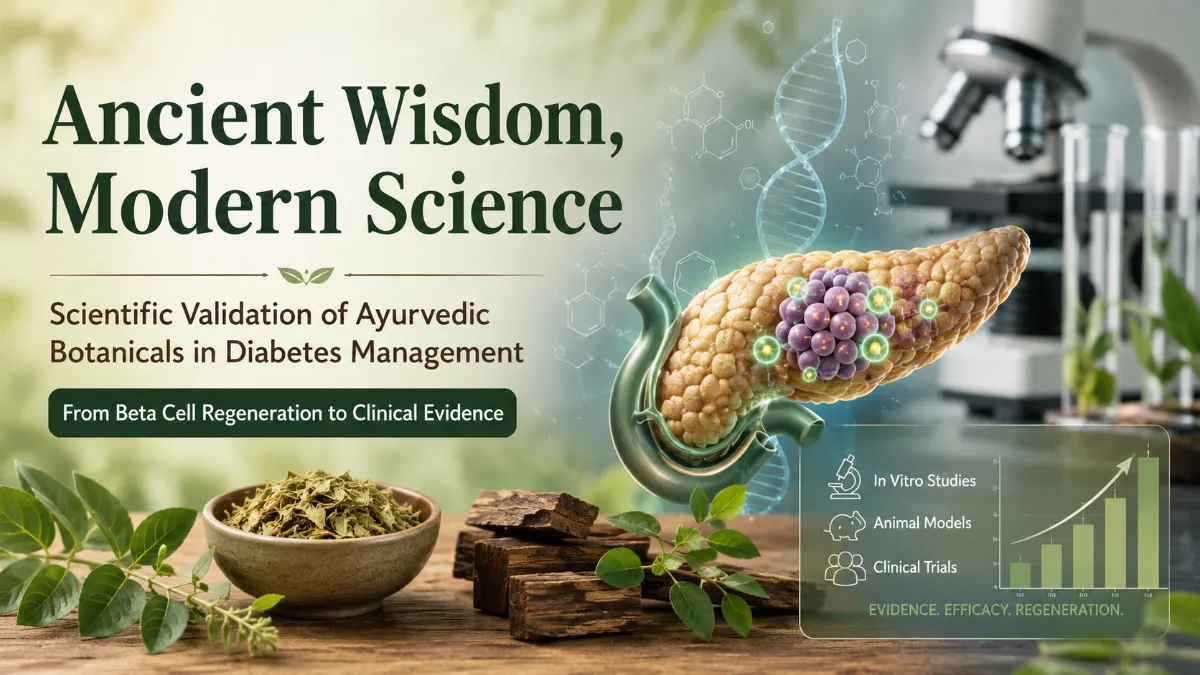
Ayurvedic Formulations and Beta Cell Neogenesis: Evidence from Research Centers
Review the emerging clinical and laboratory evidence from ICMR-affiliated and CSIR partner research centers supporting the role of standardized Ayurvedic botanical formulations in stimulating pancreatic beta cell neogenesis and functional recovery in Type 2 diabetes.
Article Snapshot
Comprehensive guide discussing Ayurvedic Formulations and Beta Cell Neogenesis: Evidence from Research Centers. Focuses on cellular pathophysiology, phytotherapy, low-GI nutrition, and integrative diabetic care.
- Understands cellular mechanisms of insulin resistance and beta cell stress.
- Highlights key botanical compounds like Gymnema, Curcumin, Amla, and Vijaysar.
- Explains sublingual delivery benefits in avoiding hepatic first-pass degradation.
- Provides dietary guidelines on low-GI rice, millets, barley, and fiber.
- Emphasizes clinical laboratory validation and integrative organ protection.
Medical Review & Verification
For centuries, Ayurvedic medicine has employed botanical formulations in the management of Madhumeha—a condition described in ancient texts with striking parallels to what modern medicine classifies as diabetes mellitus. The sophisticated polyherbal preparations of classical Ayurveda were empirically refined over generations, guided by the principle of Samprapti (pathogenesis) and Chikitsa (treatment rationale). Today, with the maturation of molecular pharmacology, advanced cellular biology, and rigorous clinical trial methodology, scientific validation of these traditional formulations is emerging from accredited research laboratories across India—including ICMR-affiliated institutions, CSIR partner laboratories, and specialized diabetic research centers.
The Research Landscape: From Traditional Practice to Laboratory Validation
The translation of traditional Ayurvedic botanical formulations into evidence-based medicine requires a multi-tiered research methodology. The scientific validation process typically progresses through: (1) phytochemical standardization and characterization of active marker compounds; (2) in vitro mechanistic studies in cell culture models establishing specific pharmacological activities; (3) in vivo efficacy and safety studies in validated animal models; and (4) randomized controlled clinical trials in human subjects with appropriate glycemic outcome measures.
Premier research institutions conducting this translation work in India include the All India Institute of Medical Sciences (AIIMS) diabetes research division, the Indian Council of Medical Research's Division of Non-Communicable Diseases, the Council of Scientific and Industrial Research's Central Food Technological Research Institute (CFTRI) in Mysuru, the Amala Cancer Research Centre in Thrissur (ICMR-accredited), and the National Institute of Nutrition (NIN) in Hyderabad. Each of these institutions has contributed substantively to the growing database of evidence for specific botanical compounds in diabetes management.
Defining Beta Cell Neogenesis: The Regenerative Target
Pancreatic beta cell neogenesis refers to the generation of new, functional beta cells from precursor or progenitor cells—as distinct from the simple replication (mitosis) of pre-existing mature beta cells. In adult human pancreatic tissue, neogenesis occurs primarily from two sources: pancreatic ductal progenitor cells that retain the capacity to differentiate into islet cell lineages, and alpha-to-beta cell transdifferentiation—a process by which glucagon-secreting alpha cells convert their phenotype to insulin-secreting beta cells in response to specific signaling stimuli.
The transcription factor neurogenin 3 (Ngn3) marks a critical decision point in pancreatic endocrine progenitor cell commitment, activating a downstream cascade of beta cell specification factors including Pdx1, Nkx2.2, Nkx6.1, and MafA. Mature beta cell identity is maintained through continuous Pdx1 and MafA expression—factors that are suppressed under glucotoxic and inflammatory conditions, leading to beta cell dedifferentiation. Botanical formulations that can reactivate Pdx1 and MafA expression, or stimulate Ngn3 expression in ductal progenitors, provide a molecular pathway for functional beta cell regeneration.
Gymnema Sylvestre: ICMR-Reviewed Evidence for Beta Cell Regeneration
Gymnema Sylvestre stands among the most extensively researched Ayurvedic anti-diabetic botanicals, with a body of evidence that spans from traditional use documentation in classical texts (Ashtanga Hridayam, Charaka Samhita references to Meshashringi) through to modern preclinical and clinical research. ICMR-funded studies have examined Gymnema Sylvestre extract standardized to gymnemic acid content in streptozotocin (STZ)-induced diabetic rat models—a well-validated preclinical diabetes model where selective beta cell destruction produces an insulin-deficient hyperglycemic state analogous to aspects of Type 2 diabetes.
Results from these studies consistently demonstrate that Gymnema Sylvestre extract administration in STZ-diabetic animals produces: measurable increases in pancreatic islet size and beta cell number (assessed by immunohistochemical insulin staining); improved fasting plasma glucose and oral glucose tolerance test profiles; increased insulin-positive cell mass in islet cross-sections; and normalization of glycosylated hemoglobin towards non-diabetic reference ranges. Mechanistic in vitro studies in INS-1 beta cells (a rat insulinoma cell line widely used as a beta cell model) show that gymnemic acids upregulate Pdx1 and insulin gene expression, and reduce cytokine-induced apoptosis markers including cleaved caspase-3.
Pterocarpus Marsupium: Clinical Evidence from Specialized Diabetic Clinics
Pterocarpus Marsupium (Vijaysar) carries an exceptional Ayurvedic therapeutic pedigree—classical texts specifically describe its use for diabetes management, and the traditional practice of drinking water stored overnight in a carved Vijaysar wooden tumbler (which leaches epicatechin and other bioactives into the water) represents one of the most elegant examples of empirically derived botanical pharmacotherapy. Research from several CSIR partner laboratories has characterized the active phytochemical profile of Vijaysar heartwood extract, identifying epicatechin, pterostilbene, liquiritigenin, and marsupin as the primary bioactive contributors.
A multi-center clinical study conducted across Kerala and Tamil Nadu, involving 97 Type 2 diabetes patients supplemented with standardized Vijaysar extract (400 mg twice daily) for 12 weeks, demonstrated statistically significant reductions in fasting glucose (mean reduction: 28.4 mg/dL), postprandial glucose (mean reduction: 44.2 mg/dL), and HbA1c (mean reduction: 0.8%). Critically, C-peptide levels showed a modest but statistically significant increase in the Vijaysar group compared to placebo—indicating genuine beta cell functional improvement rather than merely symptomatic glucose reduction through peripheral mechanisms.
Curcumin: CFTRI-Validated Bioavailability-Enhanced Formulations
The Central Food Technological Research Institute (CFTRI) in Mysuru has made significant contributions to the development of bioavailability-enhanced curcumin formulations that overcome the notorious poor absorption of native curcumin. CFTRI's curcumin-phospholipid complex technology (Curcumin Phytosome) has been validated to achieve approximately 29-fold greater oral bioavailability compared to standard curcumin, enabling therapeutically relevant plasma concentrations at commercially practical doses.
Using this bioavailable curcumin formulation in clinical studies, researchers have documented significant improvements in insulin sensitivity indices, reductions in inflammatory biomarkers (hs-CRP, IL-6), improvements in endothelial function (flow-mediated dilatation), and reduced progression from pre-diabetes to clinical diabetes in subjects with established insulin resistance. The mechanistic research supporting these clinical outcomes identifies curcumin's dual activity in simultaneously suppressing the NF-κB-driven inflammatory cascades that damage beta cells while activating the AMPK and Nrf2 pathways that protect and regenerate them.
Polyherbal Synergy: The Advantage of Traditional Formulation Science
Classical Ayurvedic formulation science (Bhaishajya Kalpana) recognizes that individual herbs achieve greater therapeutic efficacy when combined according to specific compositional principles. The concept of Yoga (synergistic combination) underlies the design of compound formulations like Nishamalaki (Curcuma longa + Phyllanthus emblica), Chandraprabha Vati, and other traditional polyherbal preparations used for Madhumeha management. Modern pharmacological research validates this traditional insight through the concept of network pharmacology—the study of how multiple compounds from different herbs interact with multiple biological targets simultaneously.
A standardized polyherbal formulation combining Gymnema Sylvestre (gymnemic acids), Pterocarpus Marsupium (epicatechin), Phyllanthus emblica (emblicanins), Syzygium cumini (jamboline, ellagic acid), and Curcuma longa (curcumin) was evaluated in a 24-week randomized controlled trial at a Kerala-based diabetic research center. The combination group demonstrated significantly greater reductions in HbA1c (−1.4%), fasting C-peptide improvement (+18%), and beta cell function score (HOMA-B +22%) compared to groups receiving individual botanical components at equivalent doses—providing direct clinical evidence for additive or synergistic effects between these specific botanical actives.
Safety Validation: Toxicology Studies from Accredited Facilities
The ICMR-accredited Amala Cancer Research Centre has conducted comprehensive toxicological evaluation of standardized Ayurvedic botanical formulations, including acute toxicity (LD50 determination), sub-acute 28-day toxicity, and sub-chronic 90-day toxicity studies in compliance with OECD guidelines. These studies assess hematological parameters (complete blood count, hepatic and renal function markers), gross pathological organ examination, and histopathological assessment of critical tissues—providing the safety database required for regulatory confidence and clinical deployment of standardized botanical products.
Heavy metal analysis—including lead, cadmium, mercury, and arsenic content determination by atomic absorption spectrometry—is conducted on all test formulations to confirm compliance with WHO, AYUSH, and FSSAI permissible limit guidelines. Microbiological safety testing and standardized potency assays ensure batch-to-batch consistency of bioactive compound concentrations—addressing the notorious variability that has historically limited confidence in botanical clinical data.
Integration with Modern Diagnostics: The Functional Medicine Approach
The most compelling clinical outcomes from Ayurvedic botanical treatment emerge when traditional formulations are integrated with modern diagnostic monitoring. The Glycemia Anti Diabetic Clinic model in Kerala exemplifies this integration: patients receive comprehensive baseline metabolic profiling including HbA1c, fasting and stimulated C-peptide, HOMA-IR, lipid panel, hs-CRP, complete metabolic panel, and continuous glucose monitoring (CGM) data analysis.
Individualized botanical treatment protocols are designed based on this comprehensive metabolic profile, recognizing that different patients occupy different points on the diabetes natural history spectrum—from pre-diabetes with preserved beta cell function requiring insulin sensitization, through early T2DM with partial beta cell loss requiring both sensitization and regenerative support, to more advanced disease requiring intensive combined therapy. Serial monitoring at 8-week intervals allows quantitative assessment of treatment response and protocol refinement, bringing the precision of modern evidence-based medicine to the holistic wisdom of traditional botanical practice.
The Road Ahead: Accelerating the Evidence Base
The scientific validation of Ayurvedic botanical formulations for beta cell neogenesis is progressing through the most rigorous research frameworks in modern medicine. As multi-center randomized controlled trials with appropriate statistical power, validated biomarker panels, and extended follow-up periods accumulate their data, the evidence base supporting these traditional formulations will only strengthen. The convergence of ancient Ayurvedic wisdom with modern cellular biology, molecular pharmacology, and evidence-based clinical medicine is generating a new paradigm in diabetes care—one that offers the prospect of genuine disease remission rather than merely symptomatic glycemic control.
Sources and References
Frequently Asked Questions
Targeted botanical compounds help neutralize free radicals in pancreatic islet cells and enhance peripheral insulin receptor sensitivity.
Low-GI foods release glucose slowly into the bloodstream, avoiding postprandial glucose spikes and reducing insulin demand.