


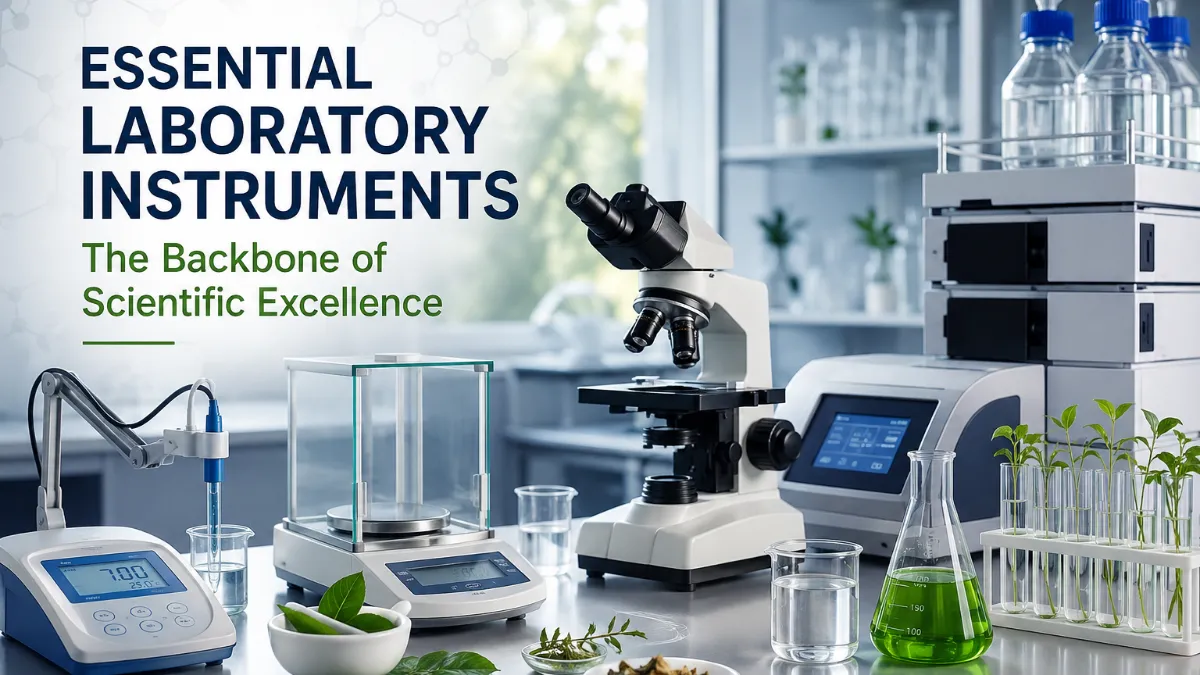
Essential Laboratory Instruments Every Modern Lab Needs
Discover the fundamental laboratory instruments that drive innovation and accuracy in modern scientific research and diagnostics. From basic glassware to advanced analytical devices, understand what makes a lab function effectively.
Article Snapshot
This article outlines the essential laboratory instruments required for modern scientific research and diagnostics, emphasizing their role in accuracy and innovation. It covers foundational equipment such as glassware, stirrers, and balances, alongside advanced analytical tools like spectrophotometers and chromatography systems (HPLC, GC). Specialized biological equipment, including microscopes, incubators, and water purification systems, is also discussed. The piece highlights how these instruments are critical for Glycemia Biotech's mission in validating raw materials, standardizing formulations, conducting R&D for Ayurvedic and nutraceutical products, and ensuring product safety, thereby reinforcing the company's commitment to science-backed natural wellness solutions.
- Basic lab equipment includes glassware, stirrers, heating/cooling devices, balances, and pH meters.
- Analytical instruments like spectrophotometers and chromatography systems (HPLC, GC) ensure precision.
- Specialized biological tools include microscopes, incubators, and biosafety cabinets.
- Water purification systems are crucial for experimental accuracy.
- These instruments enable Glycemia Biotech to ensure quality, conduct R&D, and validate ingredients.
Medical Review & Verification
In the dynamic world of scientific discovery and healthcare, the laboratory stands as the epicenter of progress. Whether advancing pharmaceutical research, developing novel diagnostic tools, or ensuring the quality of health-promoting nutraceuticals, a well-equipped laboratory is indispensable. The accuracy, reliability, and efficiency of experimental results hinge directly on the quality and functionality of the instruments employed. At Glycemia Biotech, we understand the critical role of precise measurement and controlled experimentation in developing science-backed natural solutions for wellness and diabetes management. This article delves into the essential laboratory instruments that form the backbone of any modern scientific facility.
The Foundation: Basic Laboratory Equipment
Before delving into sophisticated analytical devices, it's crucial to acknowledge the fundamental tools that enable everyday laboratory operations. These are the workhorses that support a vast range of experiments and procedures.
- Glassware: Beakers, flasks (Erlenmeyer, volumetric), test tubes, graduated cylinders, and pipettes are essential for holding, mixing, heating, and measuring liquids. Borosilicate glass is preferred for its thermal and chemical resistance.
- Stirrers and Mixers: Magnetic stirrers, overhead stirrers, and vortex mixers are used to homogenize solutions, disperse solids, and facilitate reactions.
- Heating and Cooling Devices: Hot plates, heating mantles, water baths, and ovens are used for controlled heating, while ice baths and refrigerators are used for cooling.
- Weighing Balances: Precision balances are critical for accurately measuring the mass of solid reagents, essential for reproducible formulations and experiments. Analytical balances offer higher precision for sensitive measurements.
- pH Meters: These instruments are vital for measuring the acidity or alkalinity of solutions, a critical parameter in many chemical and biological processes.
Analytical Instrumentation for Precision and Insight
Modern laboratories rely on advanced analytical instruments to gain deeper insights into the composition, structure, and properties of substances. These tools are central to research, quality control, and diagnostics.
Spectrophotometers (UV-Vis, IR)
Spectrophotometers measure the amount of light absorbed or transmitted by a sample at specific wavelengths. UV-Vis spectrophotometry is widely used for quantitative analysis of compounds that absorb ultraviolet or visible light, such as many organic molecules and metal ions. Infrared (IR) spectroscopy is used to identify functional groups within molecules and can help in structural elucidation. For Glycemia Biotech, these instruments are invaluable for verifying the purity and concentration of active compounds in our Ayurvedic and nutraceutical ingredients, ensuring the efficacy of products like our Glyco Fix Spray and U-Glycemia supplement.
Chromatography Systems (HPLC, GC)
Chromatography is a powerful technique for separating, identifying, and quantifying components of a mixture. High-Performance Liquid Chromatography (HPLC) is extensively used to analyze non-volatile compounds, such as those found in plant extracts and biological samples. Gas Chromatography (GC) is ideal for separating and analyzing volatile compounds. Both are critical for quality control, ensuring that our Health Mix Powder and Barley Rice range meet stringent purity standards and contain the specified nutritional profiles. They help confirm the absence of contaminants and the presence of beneficial phytochemicals.
Centrifuges
Centrifuges use centrifugal force to separate components of a mixture based on density, size, or shape. They are essential for separating cells from culture media, pellets from supernatants in biochemical assays, and solids from liquids. In our research into natural formulations, centrifuges are used in the extraction and purification processes for ingredients like Moringa Leaf Powder and Curcumin Powder.
Specialized Equipment for Biological and Health Sciences
Laboratories focused on health, wellness, and biological research require specialized equipment to conduct experiments involving living organisms, cells, and biological molecules.
Microscopes
Microscopes are fundamental for observing structures that are too small to be seen with the naked eye. From basic light microscopes used to examine cell morphology to more advanced confocal or electron microscopes for detailed ultrastructural analysis, they are crucial for understanding biological processes. In the context of diabetes management research, microscopy can be used to study cellular responses to different compounds or to examine tissue samples.
Incubators and Biosafety Cabinets
Incubators provide controlled environments (temperature, humidity, CO2) for growing cell cultures and microorganisms. Biosafety cabinets offer a sterile workspace and protection for both the user and the sample when working with potentially hazardous biological agents or sensitive cell cultures. These are vital for research involving the development of new probiotics or studying the effects of our formulations on cellular health.
Water Purification Systems
The quality of water used in a laboratory directly impacts the accuracy of experiments. High-purity water systems (e.g., deionized, distilled, or reverse osmosis water) are essential for preparing solutions, running sensitive analytical instruments, and maintaining cell cultures. Contaminated water can lead to erroneous results and damage expensive equipment.
The Role of Instrumentation in Glycemia Biotech's Mission
At Glycemia Biotech, our commitment to science-backed natural solutions means that precision and reliability are paramount. The instruments discussed above are not merely tools; they are enablers of innovation and guardians of quality. They allow us to:
- Validate Raw Materials: Using spectrophotometry and chromatography to confirm the identity, purity, and potency of Ayurvedic herbs and nutraceutical ingredients like Amla, Ragi, and Spirulina.
- Standardize Formulations: Ensuring that every batch of our products, from Health Mix Powder to U-Glycemia, contains the precise amounts of active compounds.
- Conduct Research and Development: Exploring new natural compounds, understanding their mechanisms of action, and developing novel delivery systems like our Glyco Fix Spray.
- Ensure Product Safety: Testing for contaminants and ensuring that our Low-GI Rice and Broken Wheat products meet food safety standards.
The careful selection, maintenance, and utilization of these essential laboratory instruments allow Glycemia Biotech to uphold its promise of delivering trustworthy, evidence-aware, and effective wellness solutions rooted in the rich traditions of Ayurveda and modern nutraceutical science.
Sources and References
Frequently Asked Questions
The most fundamental laboratory instruments include basic glassware (beakers, flasks, pipettes), stirring and mixing devices, heating and cooling apparatus, weighing balances, and pH meters. These are essential for everyday laboratory operations.
Spectrophotometers, such as UV-Vis and IR types, are important for measuring the absorption or transmission of light by a sample. They are used for quantitative analysis of compounds, identifying functional groups, and verifying the concentration and purity of substances.
Chromatography techniques like HPLC and GC are vital for separating, identifying, and quantifying components within a mixture. They are crucial for quality control, ensuring the purity of ingredients, detecting contaminants, and verifying the composition of complex samples.
For biological research, essential specialized equipment includes microscopes for observing cellular structures, incubators for growing cultures, biosafety cabinets for sterile work, and high-purity water purification systems to prevent contamination in experiments.