

How Antioxidants and Anti-inflammatory Herbs Prevent Diabetic Complications
Explore the cellular science of diabetic complications driven by oxidative stress and chronic inflammation, and learn how natural bioactive compounds like Curcumin, Moringa, Spirulina, and Amla offer protective support.
Article Snapshot
This article discusses Type 2 diabetes as an inflammatory condition where chronic glucose elevation produces excess reactive oxygen species (ROS) and Advanced Glycation End-products (AGEs). It explains how bioactive compounds like Curcumin, Moringa, Spirulina, and Amla neutralise free radicals and inhibit inflammatory pathways (NF-kB), offering cellular protection against microvascular complications.
- Diabetes is a chronic inflammatory state causing oxidative stress and cell damage.
- Advanced Glycation End-products (AGEs) damage blood vessel walls.
- Curcumin blocks the NF-kB pathway to reduce cytokine production.
- Moringa, Spirulina, and Amla offer high concentrations of protective antioxidants.
- Glycemia Biotech provides high-potency Curcumin, Moringa, Spirulina, and Amla.
Medical Review & Verification
Diabetes as a State of Chronic, Low-Grade Systemic Inflammation
For many years, Type 2 diabetes was viewed primarily as a disease of glucose dysregulation—a simple mechanical failure where the body either did not produce enough insulin or could not use it effectively. However, modern endocrinology and immunology have revealed a much more complex reality: diabetes is fundamentally a chronic, low-grade inflammatory condition. When blood glucose levels remain consistently elevated, it triggers a cascade of cellular events that generate excessive levels of reactive oxygen species (ROS), leading to systemic oxidative stress. This oxidative stress damages cellular membranes, proteins, and DNA, while simultaneously activating inflammatory signaling pathways. The persistent activation of these pathways leads to the sustained release of pro-inflammatory cytokines such as tumor necrosis factor-alpha (TNF-alpha), interleukin-6 (IL-6), and C-reactive protein (CRP). This chronic inflammatory environment not only exacerbates insulin resistance in peripheral tissues but also damages the delicate endothelial lining of blood vessels, laying the groundwork for the devastating microvascular and macrovascular complications associated with long-term diabetes.
The Pathology of Diabetic Complications: Oxidative Stress and Glycation
To understand how antioxidants and anti-inflammatory herbs can prevent diabetic complications, one must examine the molecular pathways of damage. When intracellular glucose levels are high, the excess glucose enters metabolic pathways that are normally tightly regulated. One major pathway is the polyol pathway, where glucose is converted into sorbitol. The accumulation of sorbitol inside cells creates osmotic stress, causing cells to swell and malfunction. Furthermore, this pathway depletes the cell's reserves of glutathione, the body's primary endogenous antioxidant, leaving cells highly vulnerable to oxidative damage. Another critical pathway of damage is the formation of Advanced Glycation End-products (AGEs). AGEs are formed when excess glucose molecules bind non-enzymatically to proteins, lipids, and nucleic acids. This process, known as the Maillard reaction, occurs inside and outside cells, changing the structural properties of key proteins like collagen and elastin. When these modified molecules interact with specific receptors (RAGE) on cell surfaces, they trigger a massive inflammatory response, causing cross-linking of collagen, thickening of blood vessel walls, and restricted blood flow. This dual onslaught of oxidative stress and glycation directly leads to:
- Diabetic Neuropathy: Damage to the myelin sheath and capillaries supplying nerves, leading to numbness, tingling, and chronic pain, particularly in the lower extremities.
- Diabetic Retinopathy: Damage to the tiny, fragile blood vessels in the retina, leading to leakage, microaneurysms, hemorrhages, and potential vision loss.
- Diabetic Nephropathy: Damage to the renal glomeruli (kidney filters), causing protein (albumin) to leak into the urine and eventually leading to chronic kidney decline.
- Cardiovascular Disease: Accelerated atherosclerosis (hardening of the arteries), which significantly increases the risk of coronary artery disease, heart attacks, and strokes.
Preventing these complications requires therapeutic strategies that go beyond glucose-lowering drugs; we must actively neutralize free radicals and suppress chronic tissue inflammation.
Glutathione: The Master Antioxidant and the Impact of Depletion
Within the human cell, several systems work to neutralize reactive oxygen species. The most important of these is glutathione, a tripeptide compound often referred to as the \"master antioxidant.\" Glutathione works by directly donating an electron to free radicals, neutralizing them before they can damage cell structures. In a healthy cell, glutathione is constantly recycled back into its active form. However, in individuals with diabetes, the polyol pathway consumes large amounts of NADPH, a helper molecule that is also required to recycle glutathione. Consequently, glutathione levels drop precipitously, leaving the cell defenceless against oxidative stress. Without glutathione, cell membranes undergo lipid peroxidation, which damages cellular structures and leads to tissue death. Supplementing with external antioxidants from herbs helps bypass this bottleneck by directly scavenging free radicals, protecting cells even when natural glutathione levels are low.
Curcumin: The Anti-Inflammatory Powerhouse
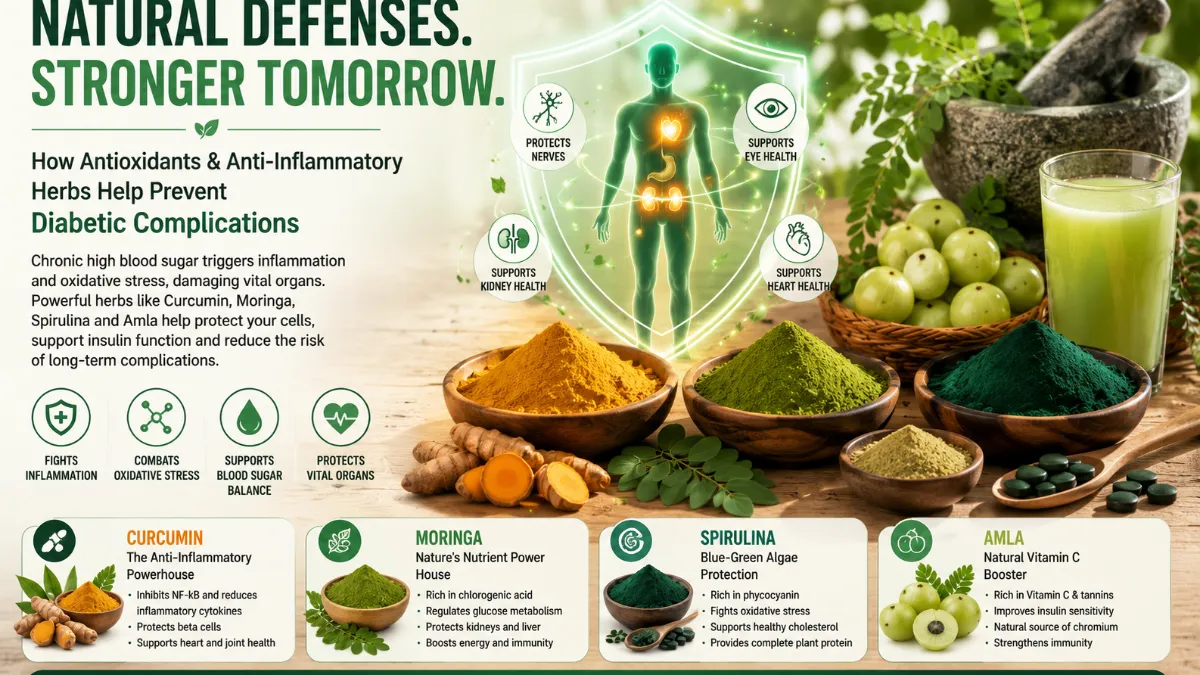
Among the natural bioactive compounds studied for their anti-inflammatory properties, curcumin—the primary polyphenol extracted from turmeric (Curcuma longa)—stands out as one of the most powerful. Curcumin exerts its therapeutic effects by acting as a natural inhibitor of nuclear factor-kappa B (NF-kB), a master transcription factor that resides in the cytoplasm of cells. Under conditions of oxidative stress, NF-kB enters the cell nucleus and triggers the transcription of genes responsible for producing pro-inflammatory cytokines (TNF-alpha, IL-6, IL-1beta) and inflammatory enzymes (COX-2, iNOS). By blocking the activation of NF-kB, curcumin effectively dampens the body's inflammatory response at its source. Clinical studies have shown that curcumin supplementation helps protect pancreatic beta cells from cytokine-induced damage, preserves their insulin-secreting capacity, and reduces systemic inflammatory markers in individuals with prediabetes and Type 2 diabetes, thereby lowering the risk of microvascular complications. Turmeric extract contains three primary curcuminoids: curcumin, demethoxycurcumin, and bisdemethoxycurcumin. Working together, these compounds provide a broad-spectrum antioxidant effect that is far superior to isolated synthetic alternatives.
Moringa, Spirulina, and Amla: Synergy in Cellular Protection
While curcumin targets inflammatory pathways, other nutrient-dense botanical superfoods provide complementary antioxidant protection:
- Moringa Leaf (Moringa oleifera): Often referred to as the \"Miracle Tree,\" Moringa leaves are packed with chlorogenic acid, isothiocyanates, and quercetin. Chlorogenic acid has been shown to regulate glucose uptake at the cellular level by modulating the activity of glucose-6-phosphatase, an enzyme involved in hepatic glucose production. The high concentration of antioxidants in Moringa helps scavenge free radicals, protecting the kidneys and liver from oxidative damage. Moringa also exhibits insulin-mimicking actions that help cells absorb sugar from the blood.
- Spirulina (Arthrospira platensis): This microscopic blue-green algae is rich in a unique pigment-protein complex called phycocyanin. Phycocyanin is a potent antioxidant that inhibits NADPH oxidase, an enzyme highly active in diabetic complications that produces destructive superoxide radicals. Spirulina also contains complete plant proteins, iron, and gamma-linolenic acid (GLA), which help improve lipid profiles by reducing LDL cholesterol and triglycerides, thereby protecting cardiovascular health.
- Amla (Phyllanthus emblica): Also known as Indian Gooseberry, Amla is one of the richest natural sources of Vitamin C (ascorbic acid) and hydrolyzable tannins (such as emblicanin A and B). Vitamin C is a water-soluble antioxidant that directly neutralizes circulating free radicals and regenerates Vitamin E. Additionally, Amla contains organic chromium, an essential trace element that acts as a cofactor to enhance insulin receptor sensitivity and support stable glucose clearance.
Together, these botanicals form a robust defense system that shields the body's organs from the destructive forces of chronic hyperglycemia.
The Importance of Organic Sourcing vs. Synthetic Alternatives
When selecting wellness supplements to combat diabetic complications, the source and purity of the ingredients are of paramount importance. Many commercial supplements utilize synthetically manufactured vitamins and chemically isolated minerals. However, the human body is designed to absorb nutrients in their natural food matrix. For instance, the natural Vitamin C in Amla is bound to protective tannins, making it much more stable and bioavailable than synthetic ascorbic acid, which is quickly excreted by the kidneys. Similarly, organic chromium bound within the botanical matrix of Amla is absorbed far more efficiently than inorganic chromium salts. By choosing organic, whole-food extracts, you ensure that your body receives these vital compounds in their most active, biocompatible forms, maximizing their therapeutic benefit and protecting your organs from cellular stress.
Embracing Glycemia Biotech's Science-Backed Supplements
At Glycemia Biotech, we believe that high-quality, pure botanical extracts are essential for effective preventive healthcare in diabetes management. To ensure that individuals can easily access the therapeutic benefits of these plants, we have developed a specialized portfolio of premium wellness products. Our Curcumin Powder features a high-potency extract rich in active curcuminoids to provide maximum anti-inflammatory support. Our organic Moringa Leaf Powder and nutrient-dense Spirulina Powder offer easy ways to supplement your daily diet with powerful antioxidants, complete proteins, and essential micronutrients. Finally, our pure, organic Amla Juice delivers a concentrated dose of Vitamin C and natural chromium to regulate blood glucose and boost overall immunity. By incorporating these clean, research-backed formulations into a balanced daily routine, you can strengthen your body's natural defenses, protect your organs from cellular damage, and cultivate long-term metabolic health.
Sources and References
Frequently Asked Questions
AGEs are harmful compounds formed when excess sugar molecules bind non-enzymatically to proteins and lipids. They damage blood vessels and contribute to diabetic complications.
Curcumin acts as a natural inhibitor of NF-kB, a master transcription factor that triggers the production of pro-inflammatory cytokines like TNF-alpha and IL-6.